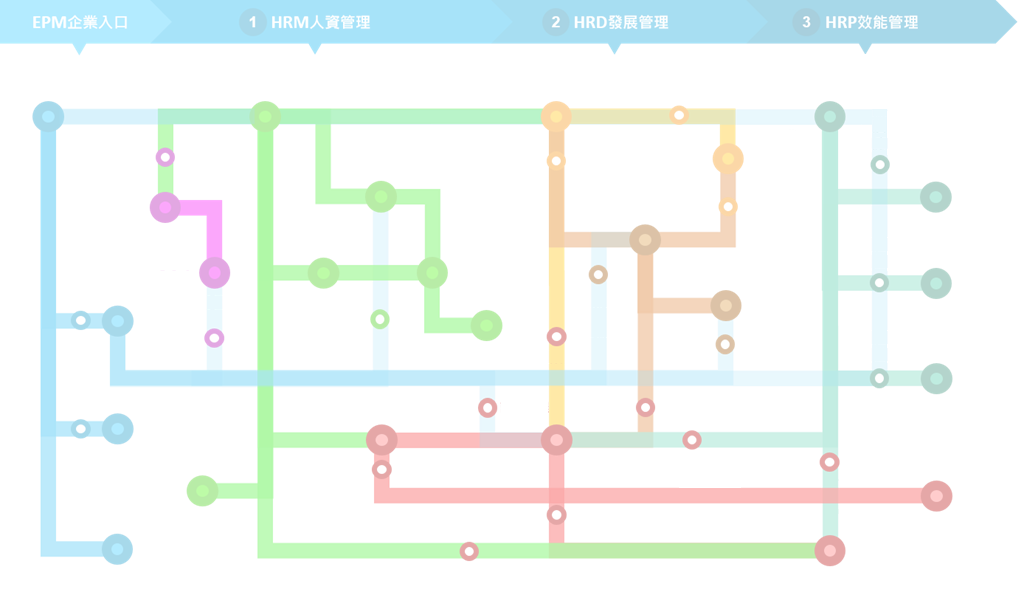


100
Portal Service Subsystem
Permission
Proposal
201
Flow
202
Resource
202
Time
203
Knowledge
230
Vacancy
230
Resume
231
Interview
Flow
210
Organization Management
211
Attendance Scheduling
Leave
Overtime
Forgot to Clock In
212
Salary Data
213
Insurance Data
214
Income tax
310
Group
250
Competency Management
250
Courses
251
Career
PDP
251
Talent
251
Training
IDP
220
Education and Training
Flow
221
Questionnaire Data
Flow
261
Goal
261
Performance
261
KPI
261
Counseling KPI
261
Organization KPI
Flow
260
Evaluation
260
Reward
262
Incentive
263
Organization
263
Target
263
KPI
240
Goal Management
Delegation
Reporting
Closure
241
Team
Issue
242
Conference
Application
243
Plan
Organizational Management
- Graphical organizational structure management supporting multiple companies, versions, and hierarchical levels within a group. All organizational unit changes can be processed automatically in batches by the system, with complete records of department and personnel adjustments retained.
- Supports cross-company dual-role management within a group, integrating department supervisor settings to establish enterprise-level approval hierarchies. A complete proxy mechanism design meets various practical approval process needs for enterprise groups.
- Provides comprehensive maintenance and management functions for employee personal data, education and work history, dependents, and other related information. All employment-related changes—such as promotion, transfer, leave of absence, resignation, or inter-company rotation—are system-supported and managed.
Attendance Scheduling Management
- Establish attendance policies by company, supporting multi-shift, multi-period, and multi-group scheduling to meet the complex shift requirements of both manufacturing and service industries. For fixed rotating shifts, schedules are automatically generated by the system, improving manual operation efficiency.
- Integrates various punch clock devices to automatically import clock-in/out records, or uses online/location-based clocking mechanisms. The system automatically compares daily attendance and sends notifications for anomalies, effectively managing employee attendance.
- Supports online self-service applications for leave, overtime, and missed punches. The system automatically notifies supervisors for approval, enhancing the speed and accuracy of processing, while enforcing attendance policies to avoid manual errors or oversights.
- Monthly attendance records and supplemental applications are automatically summarized for payroll calculation and deduction adjustments.
Salary Data Management
- Supports salary structure planning by company, allowing subsidiaries or departments to independently calculate payroll. Enables multiple payroll runs per month and separates pay periods by type of payment.
- Automatically compiles attendance, leave, overtime records, and insurance data to process payroll settlements. Retroactive deductions or payments are also automatically included.
- Provides external data import functionality to support both regular and irregular bonus distributions.
- Generates monthly payroll journal vouchers and bank transfer files automatically.
- Monthly income tax deductions are automatically included in the annual income tax processing by the system.
Insurance Data Management
- Supports Taiwan’s Labor Insurance, Health Insurance, New Pension System, and Second-Generation National Health Insurance regulations. Offers setup for insured salary brackets and insured identity categories to accommodate annual regulatory changes.
- Supports China's Social Insurance regulations, accounting for regional differences across provinces with flexible parameter settings for legal compliance.
- Handles batch processing of 3-in-1 and 5-in-1 insurance enrollment/withdrawal tasks, integrated with e-filing and automated interpretation to significantly reduce manual processing time.
- Monthly insurance premium settlements automatically calculate retroactive deductions based on enrollment timing.
- Provides annual salary adjustment insurance premium estimation tools, allowing version saving based on various conditions.
Resume & Interview Management
- Integrates with corporate websites to create a dedicated recruitment platform. Allows applicants to submit resumes online or automatically import resumes from job banks into the enterprise talent pool.
- Manages the entire recruitment process—from job posting, resume import, interview scheduling to onboarding—through streamlined system workflows, ensuring high efficiency and automation. All applicant records are preserved and seamlessly converted into employee data upon hiring.
Talent Management
- Establishes corporate standards for job competencies and grading criteria, enabling effective tracking of employee competency status. The system aligns competency gaps with job requirements and links them to annual goal setting and performance evaluation.
- Defines job-specific skill standards for language proficiency and professional knowledge, and allows management of related employee skills. Offers flexible criteria for experience recognition and provides experience management tools.
- Supports career path planning by setting internal standards for job progression and development.
- Based on job-aligned competencies, language skills, professional knowledge, and experience requirements, the system generates Position Development Plans (PDPs) as employee development blueprints. A talent-matching feature calculates the fit between employees and target roles for quick insight into talent readiness.
- Creates Individual Development Plans (IDPs) for key talent, defining clear development goals. The system generates training schedules and methods based on target competencies and expected achievement timelines.
Education and Training Management
- Establishes a standardized management function for internal corporate training courses, aligned with talent management and job requirement criteria to set training course benchmarks.
- Develops personalized learning plan blueprints for employees based on their individual development plans or performance coaching plans, enabling employees to track training goals and monitor execution status according to training results.
- Supports annual course planning and internal course announcements through actual course scheduling. Employees can register online or be directly assigned to participate in internal training courses. Departments can also independently organize courses, with options for single-session or multi-phase course formats to meet practical scheduling needs.
- Provides external course training application functionality, integrating online approval workflows with options for individual, proxy, or group applications. The system automatically notifies the approving supervisors and coordinators for review.
- Offers features for uploading reflection reports and integrates online survey designs, supporting online testing and post-course satisfaction evaluations as part of training assessments.
Goal Management
- Systematically manages organizational goals at the company and department levels, with hierarchical planning and strategies cascading from upper to lower departments, extending down to individual employee goals to effectively promote and implement a goal-oriented performance management system.
- Provides management mechanisms for the goal execution process, including setting work standards, task delegation, and progress tracking. A personalized goal task dashboard helps employees focus on key tasks and receive execution status feedback, while regular progress reports are submitted to relevant supervisors for monitoring and feedback.
- Features a unique work points system that automatically calculates quantitative performance indicators related to tasks in real time. Through systematic resource and time tracking analytics, it effectively assists supervisors in monitoring employees’ goal execution status at any time, ensuring departmental goals are met.
Plan Management
- This system provides time-oriented project management features to support goal implementation, offering control over project initiation, progress tracking, and closure.
- It includes work hour standards and operational process management, integrating internal work standards into a systematic control. The system automatically links various operational tasks, thereby improving team execution quality and work efficiency.
- Furthermore, it offers a dedicated desktop for project managers to instantly monitor the progress of their assigned projects.
Team Management
- Provides managers with a departmental management dashboard for real-time insights into team performance indicators and individual employee performance analysis, enabling quick identification of efficiency bottlenecks and maintaining smooth departmental operations.
- Features an exclusive monthly departmental performance analysis, offering executives a clear view of each department's current status and serving as a key reference for evaluating departmental performance.
- Includes issue management tools to support both horizontal and vertical team communication. Discussion workflows are defined based on issue types, with automated notifications sent to relevant members to engage in collaborative discussions—becoming a vital source of team knowledge.
- Goal-oriented meeting management functions offer automated scheduling and decision-tracking mechanisms, ensuring effective follow-up on team meeting resolutions.
Performance Management
- Supports two types of performance evaluation: individual goal-based assessments and qualitative evaluations, with flexible configuration of evaluation periods and methods based on the evaluation target.
- Allows setting four types of performance goals: organizational, competency-based, qualitative, and personal. Each type links to departmental goals, role-based competencies, or qualitative evaluation forms. Personal performance goals and their weightings can be flexibly defined based on job characteristics.
- Integrates ongoing performance data from goal management, automatically compiling execution results during evaluation periods. Multiple evaluation methods—such as self-evaluation, peer review, subordinate feedback, project manager input, and direct supervisor assessment—are supported to ensure objective evaluation. Workflow integration enables effective control of the entire evaluation process timeline.
KPI Management
- Systematically defines key quantitative indicators and their calculation methods, providing customizable formula settings and the ability to link with external data sources for scheduled automated statistics.
- Supports departmental key performance indicator (KPI) planning by automatically generating goal settings within a defined period, along with analysis of actual results and achievement rates for each KPI.
- Provides batch report configuration for KPI statistics, simplifying the process of compiling results for both departmental KPIs and individual performance indicators.
- Offers analytical tools for KPI results and data management, including performance contribution analysis based on each indicator.